
WIN187. What We Learned from Our First Full Cycle Syndication Deal with Sean Poggi and Chris Shepard

Intro speaker: Welcome to the Westside Investors Network (WIN) your community of investing knowledge for growth. This is the real estate professionals investing podcast for real estate professionals by real estate professionals. This show is focused on the next step in your career, investing. Thank you for listening. And please, if you like our content, rate us on your podcast provider.
Just a quick disclaimer, the views and opinions expressed in this podcast are for educational purposes only and should not be construed as an offer to buy or sell any shares or securities, make or consider any investments or take any other action.
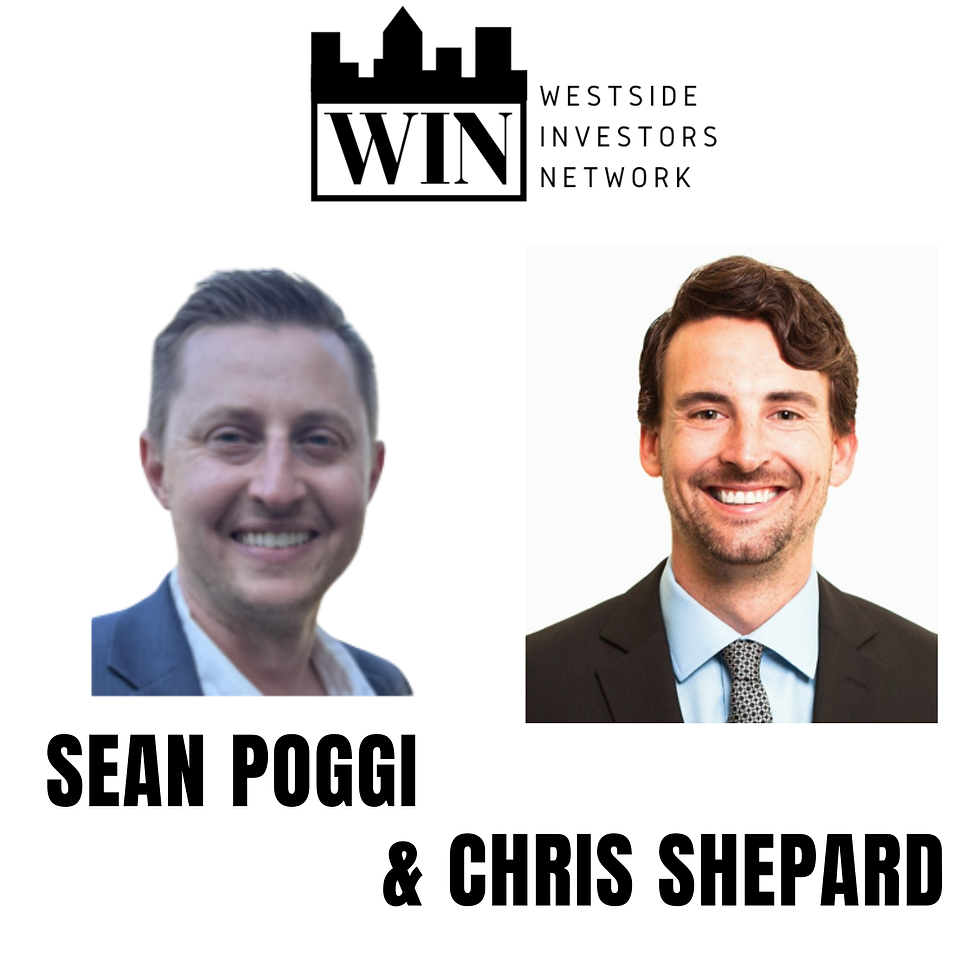
Sean: All right. Hello there and welcome. I'm going to start off with some introductions here because I haven't had a chance to meet many folks here as of yet. And you're probably wondering whose face this is. My name is Sean Poggi and I'm an asset manager at Uptown Syndication.
I'm joined here with Chris Shepherd, who you all know. But really excited to chat today because we're going to kind of dig into a deal that happened before I was around at the company and I'm really curious to learn a ton more about it. So we thought we'd get Chris on here and kind of talk specifically about the deal, kind of dig into it because it went full lifecycle, which is really cool.
Chris: Yeah. And it's our first full cycle deal. So pretty exciting stuff. Yeah, we're really pumped to have Sean on board. He's been with us for what, six months?
Just over six months. Yeah, that's pretty crazy. God, that went fast. I mean, have a six month old now too. So yeah, funny how time flies.
They say the days are long.
Sean: And the years are short.
Chris: Yeah, my goodness. Well, yeah, we're going to talk about Southwest 68th. It was a nine unit that we purchased in 2019. So Sean is gonna interview me and I'll try and remember the deal the best that I can. I've got some notes here.
So don't mind us if we're looking at a computer screen here and there.
Sean: Yeah, we're just talking about how time flies by and we have purchased back in 2019. But let's take a moment in time, go back to 2019 and we want to talk about this Southwest 68th deal. And what got you excited and the company excited about this deal? What do you think you saw that maybe others didn't? Like why was this the first deal?
Chris: Yeah, well, I think that AJ and I were extremely excited about doing a syndication. Like this size of deal was something that we could have done ourselves, but we specifically wanted to put the syndication structure together. And so we did the work to get all of the legal structures and make sure that we were doing it the right way. This particular deal was, it had some hair on it. Of the units, we ended up not being able to get a Freddie Mac loan because the inspection was so bad.
And our mortgage broker said that he's never had a property fail an inspection, he's never had that happen in his career, and this was our first Freddie Mac small balance loan, And so we ended up having to buy it with hard money and bridged that to refinance. And so we got into that, and there was one really bad unit that had a lot of mold in it, And it was really tough to try and figure out. Honestly, I still have no idea exactly why there was so much mold in that unit, but we ended up taking it down to studs and I think we let it sit for a few weeks just trying to figure out where the moisture was coming in from and there was just none. But then we put it all back together and new roofs on the properties, I think four buildings. And so we put a new roof I think on three of them.
Wow,
Sean: and you're kind of jumping ahead, I'm gonna slow us down a little bit here and take us back because I want to continue talking about the acquisition here. You mentioned a piece not being able to get Freddie Mac and yeah, to be able to set up this loan. But so how did you underwrite it? And it sounds like maybe it changed after the contract.
Chris: So our underwriting basically rents were nine units were averaging just over $1,000 per month. I think current rents were at maybe $10,500 And the unit mix was two bedroom, one bath, two bedroom, two bath, three bedroom, two bath, and a four bedroom, two bath. And so there were in townhome units, the rents were extremely low at this property and that was the big opportunity and the landlord was neglecting it. And we, yeah, and then as well, we managed to argue for a $75,000 credit, already a pretty low price. And that honestly, I didn't know anything about negotiating multifamily properties at that point because essentially, we bought most of our stuff off of
Sean: the RMLS.
Chris: And so, we ended up learning a lot on this deal.
Sean: Yeah, well, I'll tell you, it definitely has applied the negotiating to future deals. I've seen that in action. Yeah, well, yeah, 2019 was a different time as well. And kind of getting into around that time, kind of talked about rents already, kind of what they look like, but then we had some things happen in COVID and like, that was a huge landscape change. And it was curious how that impacted maybe underwriting or unforeseen items that kind of popped up during that time or that impacted the overall deal itself and kind of working through that?
Chris: Yeah, I mean, were refinancing right at the time of COVID. And we had to have a year of debt, basically debt payments that went into a COVID reserve because nobody knew what was going to happen in there. They just weren't going to give out refinance proceeds. Even though we were in the middle of a refinance, the finish line kept moving. But honestly, COVID didn't really change the rental landscape that much.
Some of the things that were done by the government during COVID dramatically impacted the market. And in 2022 and 2023, it was pretty detrimental to real estate, or at least operating investment properties. But at the time, our business plan was performing pretty great. And we finished a pretty large value add.
Sean: And so yeah, purchase in 2019, refinance in 2020 out of that hard money loan, which I'm
Chris: sure felt pretty great. Well, learned a hard lesson. Looking at our PowerPoint for the acquisition, I believe we were trying to raise, but we ended up raising $400k and our value add project proposed was $150,000 And we were planning to have that happen over twelve to eighteen months, new roofs, landscaping, minor mold remediation in two units, painting the exterior. And then that was for Building 3 And 4. And then one and two are doing roof repairs, landscaping and painting exterior.
And then budgeting for turnovers as well. But the thing is that when we had to change course from a Freddie Mac small balance loan, which was going to have really high proceeds to a hard money loan, the hard money loan had really high proceeds, but we needed to replace the hard money loan as quickly as possible. And so we repaired that one down unit, which was what was the major issue. And once we got that down unit done, and I think we did a couple roofs and painted, and we're like, okay, we've done our big value add project. We are in this, and then we added appraised, and the property I think appraised for like 1,800,000 pretty much immediately.
And so we were, we bought the property for 1.2 less the 75 ks. So we're in it for 1.15 plus, you know, maybe 150 ks of value add. But, and we got a 1.8 appraisal. And so 80% of 1.8, it's going to be like close to 1.45, But we were only able to get a loan for 1.1. We refinanced it too quickly.
We were stuck at loan to cost. And I think that essentially, you know, they only gave us credit for a cost of 1.1, you know, 1.15 or something. And that was pretty brutal for us, because we were going to pay everybody's cap. I mean, we I think that we paid maybe like 75 ks of capital back on that refinance, but we were going to pay, you know, the difference in another $275,000 of the $400,000 raised back. And so essentially, 80% of the capital would have been paid back within six months.
And I mean, that really shot us in the foot because we would have had like massively higher returns.
Sean: Well, we'll get to that. So it sounds like a few curveballs happened throughout. We talked about the mold remediation, which was substantial, got a bunch of roofs, then the refinance providing some challenges and getting used to some hard money debt within that time period. Were there any other curveballs that kind of happened because this deal was dispositioned in 2025? Anything else that you can think about that kind of, I mean, sounds like a lot already.
Chris: And now here's a word from our sponsor.
Ad speaker: Get things done while you're on the move. Learn more about working with a virtual assistant through off-site professionals. It's a great way to get all the things done that you need to get done. Have freedom in your time and streamline your life by automating your business. Stop spending time on the tasks that you can delegate and start spending more time on your superpower.
Call us today at (503) 446-3177 or visit our website at off-siteprofessionals.com.
Ad speaker2: Uptown Syndication is now offering a syndication coaching program for you to take your real estate portfolio to the next level. This is your opportunity to have experienced syndicators, AJ and Chris Shepherd, coach you on your way to controlling your real estate investing future. Our coaching program will provide you with the tools and framework needed to begin syndicating real estate in your target market. Go to uptownsyndication.com today to learn more.
Ad speaker: Hey. Let me ask you. What if tax season was actually exciting? I know. Sounds crazy, but not when you've got the right playbook.
At mymoneyworksforme.com, we put together the pro tax strategies playbook that real estate professionals use that you may not know about. You'll learn how to crush taxes with depreciation and rep status, how to stack smart write offs from the a rule to vehicles. And the ultimate wealth hack, ten thirty one exchanges and vacation rentals. It's free. It's powerful.
And it's waiting for you at mymoneyworksforme.com because your money should work as hard as you do.
Chris: Well, in hindsight, we could have sold the property for $2,200,000 maybe $2,300,000 in 2021 or 2022. And we just, I guess weren't positioned, but we weren't poised to sell it. We were more focused on acquisitions. And so I think
Sean: we tried to sell it at
Chris: the 2022, and basically it sat on the market for three years. We eventually got 2,000,000 out of it, which I feel like we did okay, but we left some money on the table there. Somebody got a good deal on it and we got into, we got our first full cycle deal and we learned a lot.
Sean: Yeah, so let's talk about those returns a little bit. You know, 2,000,000 on a purchase price at one point two minuteus the 75 ks is quite a bit. So what did it look like in terms of returning to limited partners? What was the overall IRR on the deal come 2025?
Chris: So we raised $400,000 and we were able to return about $910,000 to investors, which was great. We had multiple investors move forward with us on a $10.31 exchange into another property that we just closed on, and Sean we were just chatting about it today, very excited about that 40 unit complex. But the IRR was 21%, and we advertised a 19% IRR on this project. Honestly, with all the curveballs that happened, it just went to plan and we benefited from some pretty amazing rent increases. Even though rents in Portland had really gone up quite a bit in 2015, 'sixteen, 'seventeen, 'eighteen, there were still some properties available to purchase where the rents were still low and there was still upside.
And so that was, I guess 2019 was kind of early in the cycle. I mean, 2011 was probably the bottom of that cycle. And then the top of the cycle was early twenty twenty two. So it was pretty long run. Yeah, that was good timing to capture a good solid move in the market.
So we were certainly assisted by the market, but also the value add that we were able to do, it just the forced appreciation was the majority of, because we purchased the property under market value, which is one of our, the most important thing that we do when we buy a property, and then apply property management value add and construction value add to maximize the NOI. And then pretty much immediately we purchased the property for 1.125, and then it appraised for 1.8, like six months after with minimal CapEx. So we were able to, without any, the market appreciation, there was quite a steep curve up and then a steep drop, but still we benefited from that. So
Sean: I mean, yeah, talking about 21% IRR definitely is a solid, solid deal and investors are very happy about that. And I think that's just been a niche that I've noticed from being at a company for a while, finding those under market rents, having a plan to add value to properties and get it to a space where impacting possibly the tenant experience, investor experience, and then the power of real estate, right? Over time. And I think that was probably a challenge, right? Is when you- I
Chris: mean, yes, the real estate over time, but basis, I mean under market rents, yes, but making sure that you're not paying too much per door or too much for the property at that moment of time. Because the number one thing that we can do is force the appreciation up by pulling a few levers that we know how to manipulate to get the property operating at its highest and best value. Essentially we're taking something that is dilapidated and needs repair to, okay, now it's back up to its full retail value. And then our exit strategy is to sell to somebody who essentially wants something that is relatively simple and straightforward, it has good bones, and there's small optimizing things that need to be done. And so when we sold this property, we sold it at $2,000,000 and I believe that we had average rents of about $1,700 per unit.
So we took rents, I can pull it up, well actually, rents were $10,700 when we got the property, and then I want to say that we were somewhere around 17,000 or $18,000 per month when we sold the property. And so the bulk of the work was done, and as well we implemented RUBS, so tenants were paying for their own utilities. Yeah, I mean the property was just in general more appealing.
Sean: It seems like some solid value add to that property and getting it in a great spot. And so with the first deal coming full life cycle, you mentioned a couple of learns through that, but what do you think the single biggest learn you took away from that deal to future deals? Oh, there's just so many elements.
Chris: Originally I thought the loan to cost situation was a really big learning, but honestly, like now, now the interest rates are much higher, and I mean honestly having a huge loan doesn't actually benefit the P and L that much because there's not as much yield on a cap rate versus mortgage interest. Like if your cap rate, or essentially your yield on cost is the same, or if your yield is less than the interest rate, you're actually, you know, that's negative leverage, and so you know, you're actually paying into the deal when you as you get a bigger loan. So I thought that that was probably the first learning, most important. We still think about it a lot today, but yeah, I mean, that's just like, yeah, I mean, the loan stuff, I mean, we had some major curveballs with COVID and just dealing with banks and through Yeah, the
Sean: loan packages, exploring those, which is a big thing to get into with syndicating properties. I think we're exploring some of those options right now as we continue to do future deals and looking forward to deals eleven and twelve coming up here soon, which is exciting as we continue to grow this opportunity. And I think that's something I've also appreciated has been the consistency of focusing on real estate. And, I know some people talk about this market being a tough market to be in, you specifically see opportunity, which I think having that mindset is so huge to think about that value add and what kind of impact we can have on investors and improve these properties around the Portland Metro currently and hopefully other areas as well.
Chris: Yeah, that is the mission. We purchased this property from a landlord who is completely neglecting property, and there were people living in some pretty bad units. And so getting those units back in the housing stock and taking them out of some unsafe conditions, yes, we increased the rents, kind of brought it to a little more to market rate, but having tenants live in unhealthy conditions, there's just so many more. There's, I think 35,000 available, or not available, but there's 35,000 units in Portland. Just bringing up that level, I mean, we're not making that huge of a dent, but bringing up the level and the quality is something that we're passionate about.
Yeah.
Sean: Thanks for sharing. Anything else you want to share with the folks here that I didn't get a chance to ask you about? Know I was peppering you with some questions there.
Chris: You were mentioning this market cycle. One of the things that many real estate investors talk about is you just can't time the market. And I believe that you can understand the market and learn about it. But I also agree that it's not worth it trying to time the market. There's absolutely no reason to wait to get into real estate.
And, you know, if, if you're on the sidelines, like, it just doesn't make sense to wait, because this is a game or this is an investment strategy of compound interest, compounding returns. And so I bought my first deal in 2006, and I absolutely lost 50% of my value on that first deal. But that was a relatively small deal, and kept going, I bought one in 2,007, we bought deals in 2008, we bought a bunch in 02/2010, and as the market bottomed out, and then there was some really good deals available, and we tried to buy as many as we possibly could, and then the market started ticking up, like that compound interest and or compound return, along with the sweat equity and just the forced appreciation strategy really paid off massive returns. And just the every day habit of what can you do to further your investment strategy is acting now and taking responsibility and taking a little risk is absolutely the best thing to do when it comes to investing.
Sean: Hindsight 2020. I mean, people look back, I wish I invested in the S and P five hundred last year. Well, you know, your time is now. Yeah. Similar with real estate.
Absolutely. Well, thank you, Chris. Appreciate you kind of sharing about that deal. I was curious to learn more about it as I had heard about it as I came on board, but the details within that and seeing how they've been applied to future deals, I can definitely see that in action and seeing this guy underwrite deals is fun to watch and I'm learning a ton and I can definitely see you applying some of the knowledge from that first deal to these future deals that were having happened, which very excited for next couple months of deals, and hopefully a bunch of future ones to come. Absolutely, you
Chris: know, ten thirty one exchanges forward. And just that compounding, you know, like, we're six years in to a pretty exciting journey. And, you know, all not all, not every single deal is going to be a 21 IRR. But we are going to manage those properties the best that they possibly could be managed. And there will be good ones.
There's going to be good ones in ten thirty one exchanges forwards and the ones that are a little tougher. We're still going to be returning capital and returning preferred returns on those deals. And essentially, there will be opportunities to move forward with those. And we'll have many more deals coming up. So I'm really excited about the future too, and I'm definitely ready for some movement in this market.
Sean: That's my
Chris: positive momentum. Been getting crushed past few summers, so I am crossing my fingers on this summer, and then eventually we'll start the upward trajectory that we need.
Sean: That hindsight is going to be twenty twenty. Think hopefully well positioned right now for the future. Thank you, Sean. Thank you, Chris. Appreciate it.
Chris: All right, let's go. Thank you
Intro speaker: for listening to this episode of the Real Estate Professionals Investing Podcast on WIN, your community of investing knowledge for growth. We hope that this episode has increased your knowledge and added value to your path to freedom. If you would, please take a second to rate us so that we can get more great investors to interview. If you or someone that you know wants to be on, please visit westsideinvestors.com and fill out our form to be on the show. Thank you again, and enjoy your day.
Comments